The Idea Machine
A slot machine for product ideas.
About
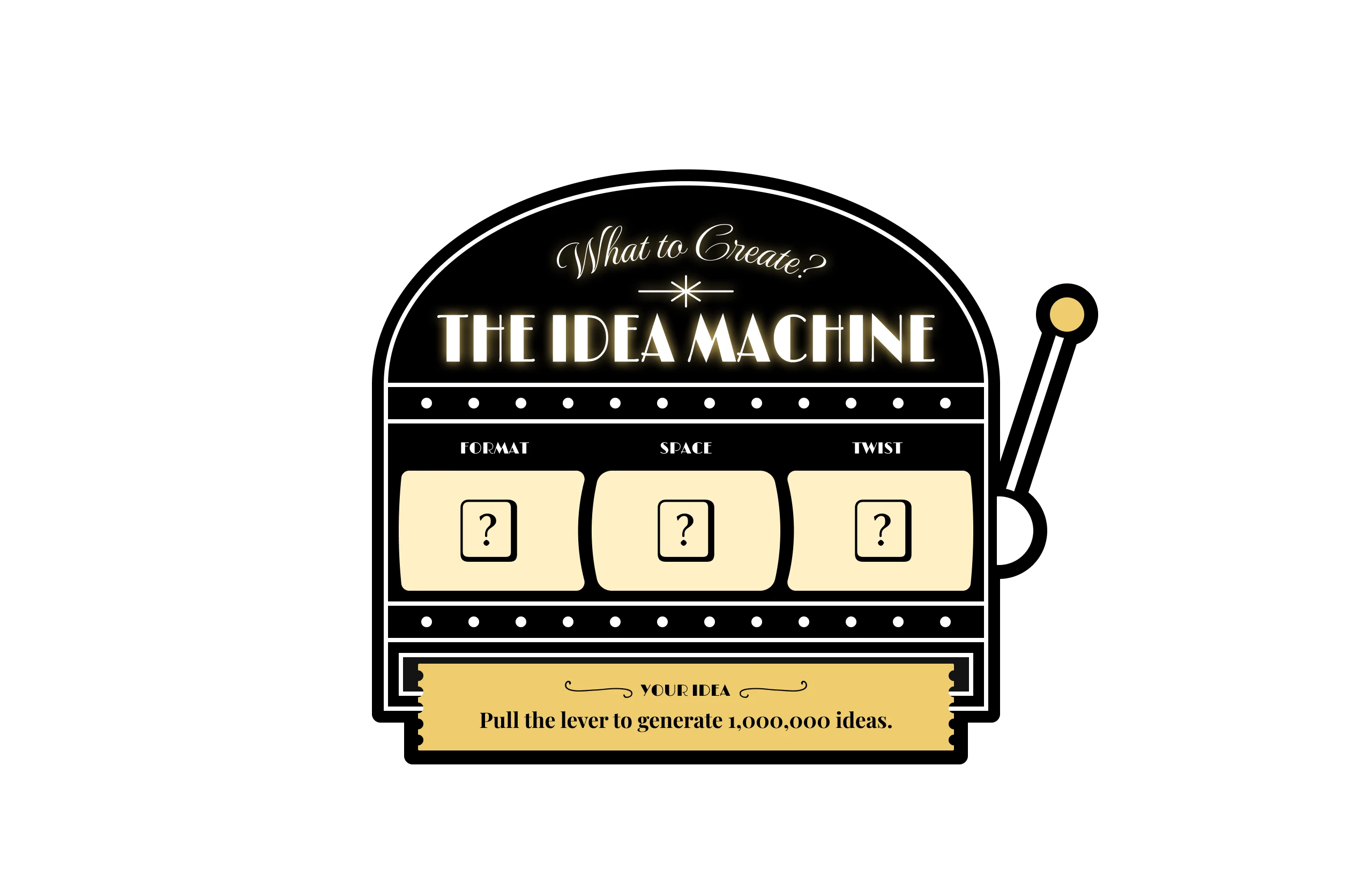
The Idea Machine is a slot machine for product ideas. Each pull lines up three reels: a space in everyday life, a product form, and an unexpected twist. It’s built on a simple belief: good ideas often begin with an unlikely combination — and a little serendipity.
[Video 1] Showing the idea machine in action.
Why I built this
“It’s never a better time to be a builder.” But before building anything, you have to have an idea.
To me, a product idea has two fundamental elements: what space it’s solving a problem or creating value in, and what form the product takes. Instead of searching for a viable idea in our brains, why not try a couple of random combinations first and see what hits?
So I built this idea generator that creates a random combination of a space in human’s everyday life, a product form, and a little twist just for fun.
This was also a “learning by doing” project — but not about the building. I already know how to design and ship a small product. What I didn’t know was everything that comes after: how to get it in front of people, and how to read what they actually do with it once it’s there.
What happened after launch
Before launch, I mapped out the standard product funnel: reach, acquisition, activation, retention, referral, revenue, and profit. I crossed out revenue and profit since it’s a free, open-source site. I also combined acquisition and activation, since the whole product is one action: pulling a lever.
Two weeks of Google Analytics data, from launch on July 31:
- Reach: 629 new visitors
- Acquisition / Activation: 367 pulled the lever (58%), about 3 spins each
- Retention: 19 came back the next day (3%)
- Referral: 9 clicked the share button
How I read it: The launch validated the product and the interaction. Most people who arrived tried it, and they tried it more than once. The lever works. But it isn’t an everyday utility, so I expected low retention — honestly, I was a little surprised anyone came back the next day at all. The sharing feature, though, is a miss: with only 9 clicks out of 367 users, either people don’t feel the urge to share a random idea, or they never noticed the share button.
What I’d do differently: Set up channel tracking before launch. Sidebar was my only traceable source (94 confirmed users), and there’s a direct-traffic spike I can’t attribute to anything. Next time I’d launch across more channels, or launch more than once, and be able to say which one worked. And the share flow needs real design work: make it more obvious, and make the thing you’re sharing worth showing off.