Design Systems, Revisited
November 11, 2026
I still remember when I started my career as a UX designer: the design system was a top priority for our small but mighty UX team building internal SaaS products inside a Fortune 100 company. That was the beginning of 2023, when AI was starting to boom but still in its infancy.
The promise of the design system seemed enticing: pay a little overhead up front to save design and development time later, while keeping the design and branding consistent. So we built the component library and the design guidelines, set up a Figma library and a React library, and kept them in sync. The dream was for designers to grab any component from the Figma library, and for developers to grab the corresponding component at handoff.
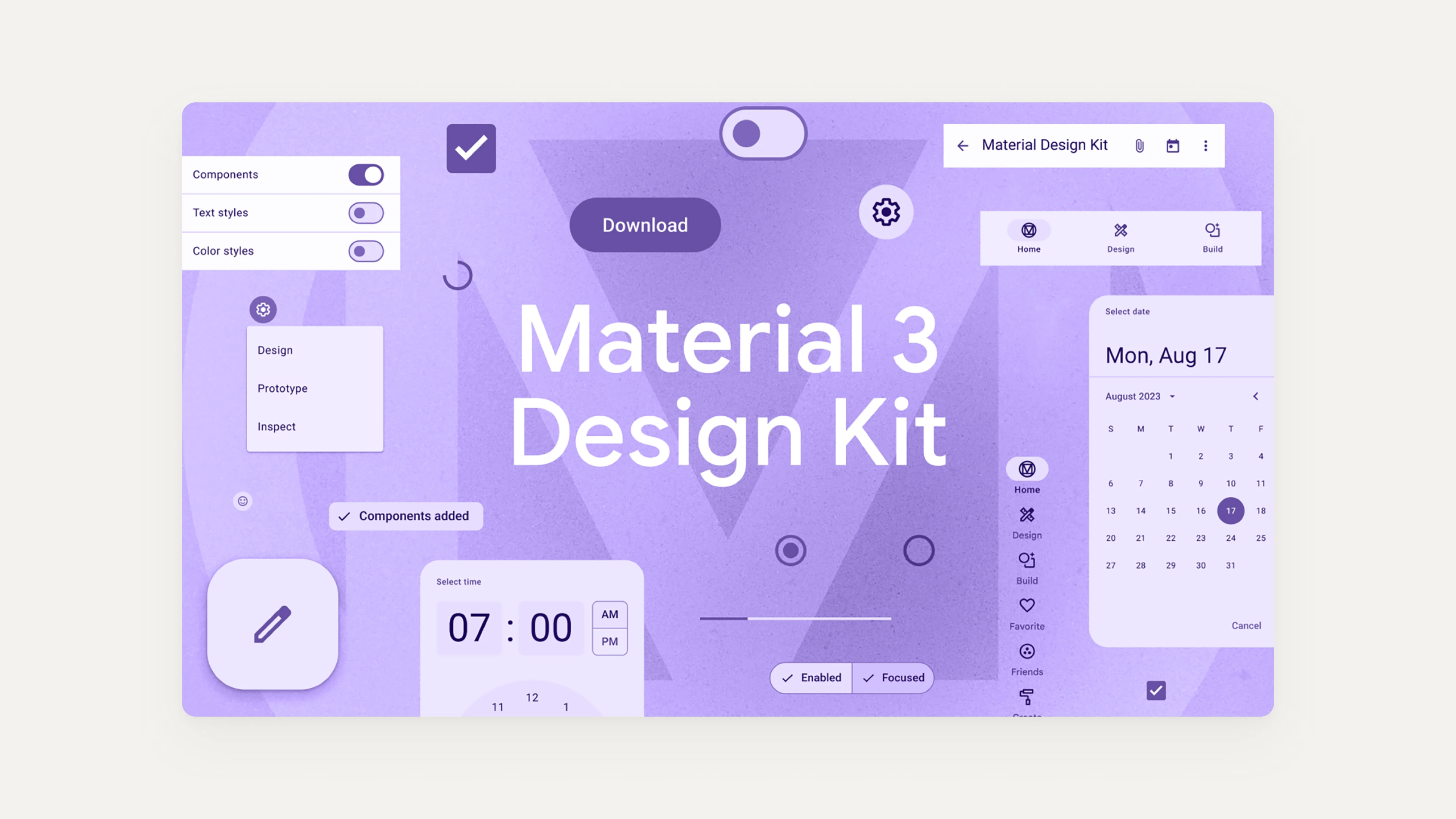 [fig 1] Google's Material 3 Design Kit for Figma, the state-of-the-art design system in 2023. The same components also ship as code, the Figma-and-code pairing our team kept in sync.
As attractive as it seemed, maintaining the design system was becoming more of a burden than a blessing: updating components as needed, debating whether we needed a new component or could just modify an old one, nagging the engineers to do the updates for us. But at that time, we still had some buffer in our schedules, so working on the design system was more like a side hobby for us designers, a way to practice and up-skill our craft.
However, as the economy continued to weaken, massive waves of layoffs swept the tech sector. And whoever survived the layoffs had to do the same amount of work with fewer team members. With resources that scarce, the design system went to the backlog. Its ROI wasn’t visible enough to the higher-ups.
So what now, with AI?
Fast forward to 2026: AI agents can build an entire app from a single prompt. Next to that, maintaining a design system the old way seems a little outdated. So what's the new standard for design systems? Or, the bigger and scarier question: are design systems still relevant?
There’s no definite answer yet. Every company is handling its design system differently, depending on its size and needs:
Case study 1: Linear
Karri Saarinen on the Linear design system (X thread)
Even before AI, Linear had moved away from the “traditional” Figma-and-code sync. It’s often cited as the lightweight model: no design system team, no councils, no naming debates. Everyone contributes to the system as part of the toolchain and improves it as they go.
Case study 2: Numeric
Holistic Design Systems for the AI Coding Era, Chris France
Numeric still has a design system, but it's not in Figma anymore. Designers are now designing directly in the “browser”. No need to maintain a Figma library. The result: “fewer obvious UI defects and communication issues,” and designers free to “move up the ladder of abstraction.” This might be a good fit for start-ups that don't have the resources for a dedicated design system team.
Case study 3: Atlassian
Atlassian Design System: Building the context engine for the AI era
Atlassian's design system is evolving to meet the needs of AI agents. They argue that design systems are even more important in the era of AI, since they can provide the context that guides both people and AI agents. And the context here is not just UI components, but the design rationale, accessibility requirements, engineering practices, and product knowledge needed to make good decisions.
Conclusion: Going back to the basics
At its core, a design system is a guideline for automating design decisions. Its concept and structure still have value; only the form has changed. As a single source of truth for design decisions (brand consistency, component standards, accessibility), it gives every agent and human working on the product a shared context. However, companies are starting to move away from maintaining both a Figma library and a code base. Keeping the two in sync is just too much overhead, the same overhead my team couldn’t afford in 2023.
The code base should be the single source of truth now, since it's accessible to AI agents and doesn't depend on Figma. Is Figma still relevant? For a human designer like me, it’s still by far the best tool for pixel-perfect tweaks. But it should no longer be the source of truth for design systems.
Back in 2023, keeping design and code in sync meant nagging engineers. Now with AI, the gap between design, development, and maintenance is shrinking. Designers, developers, and AI agents are still figuring out how to work together, or whether they’re merging into one role. We don’t know.
References
- Design system 101: What is a design system? - Chad Bergman, Figma Blog, 2024
- Design systems are over. Product context is the work. - Robin Cannon, 2026
- Designing product simplicity for the AI era - Jenny Lanier Wolski, Microsoft Command Line, 2026