Config 2026: AI Lowers the Floor. What About the Ceiling?
July 10, 2026
This past Figma Config 2026 was my second Config. Unlike my first year, when I was mostly nervous and excited, this year I'm still excited — but with a much clearer goal in mind. I want to be inspired, and to find some clues to a question that's been haunting me for some time now:
What's next for me as a designer, and for design as a whole?
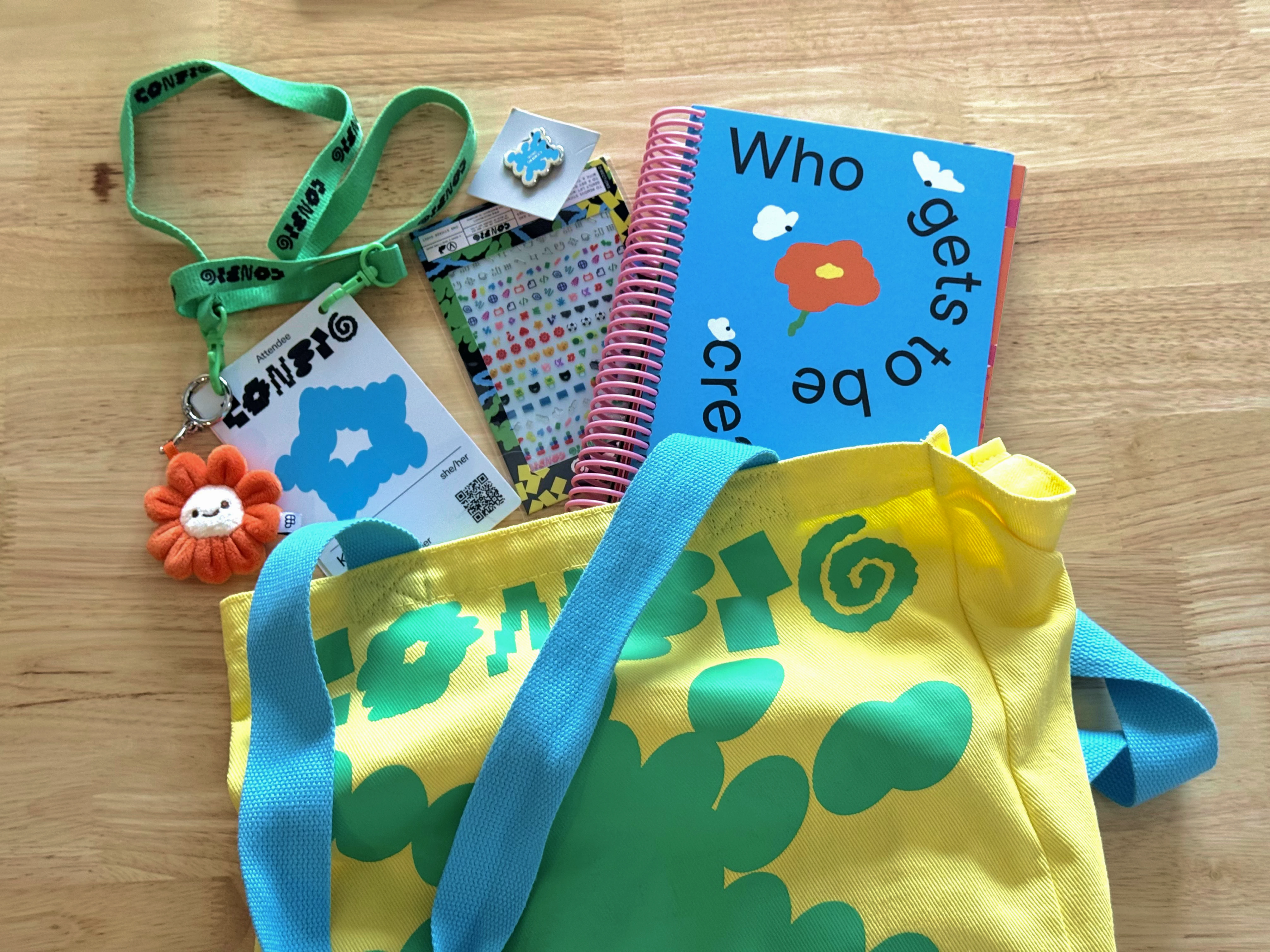 [fig 1] My Config 2026 haul.
Figma's answer: back to the canvas and the community
Figma went in a very different direction this year. In 2025, it ambitiously expanded into many new areas: Draw, Make, Buzz, and more, as it prepared for its IPO and a much bigger vision of what Figma could become. This year, even as Figma released a wave of new tools and design materials, it seemed to return to the basics: the Canvas and the Community.
The Canvas
Figma puts everything on one canvas — design, code, motion, image, video, plugins, shaders, Weave, and more — turning the canvas into a shared space for making almost anything. This unified canvas works well for the way I think: non-linear, messy, and sometimes chaotic. It gives me a medium to externalize my thoughts freely. And for designers, that externalization matters because only once a thought is outside of our heads can we begin to iterate on it, shape it, or share it with others.
For now, Figma is still the best canvas tool for me. Of course, vibe-coding tools can also help us visualize and iterate on ideas. But there's still a wall between code and something you can see, move, compare, and share.
The Community
Community here means two things: real-time collaboration and the broader community ecosystem.
Collaboration means working with others on the same medium, at the same time. This has been one of Figma's strongest moats for years. Figma has spent a long time refining its multiplayer engine, and no AI tool or platform has yet matched its smoothness and reliability.
The community ecosystem is another moat. Figma has been cultivating it for years, and it's still running strong — this year's Config is a good example. Competitors may be able to copy features, but they can't instantly recreate years of community momentum.
About AI
AI wasn't heavily emphasized in the keynote, yet it was threaded through almost every new feature — Weave, AI-generated plugins, and agents. The message was clear: AI is a powerful tool across the whole workflow, but the designer still leads. Use AI to generate the first draft and explore alternatives; then let a human review, refine, and make the final call.
Put together, the keynote reads as Figma's answer to "what's next for designers":
"Technology keeps changing, but good design has always been about people."
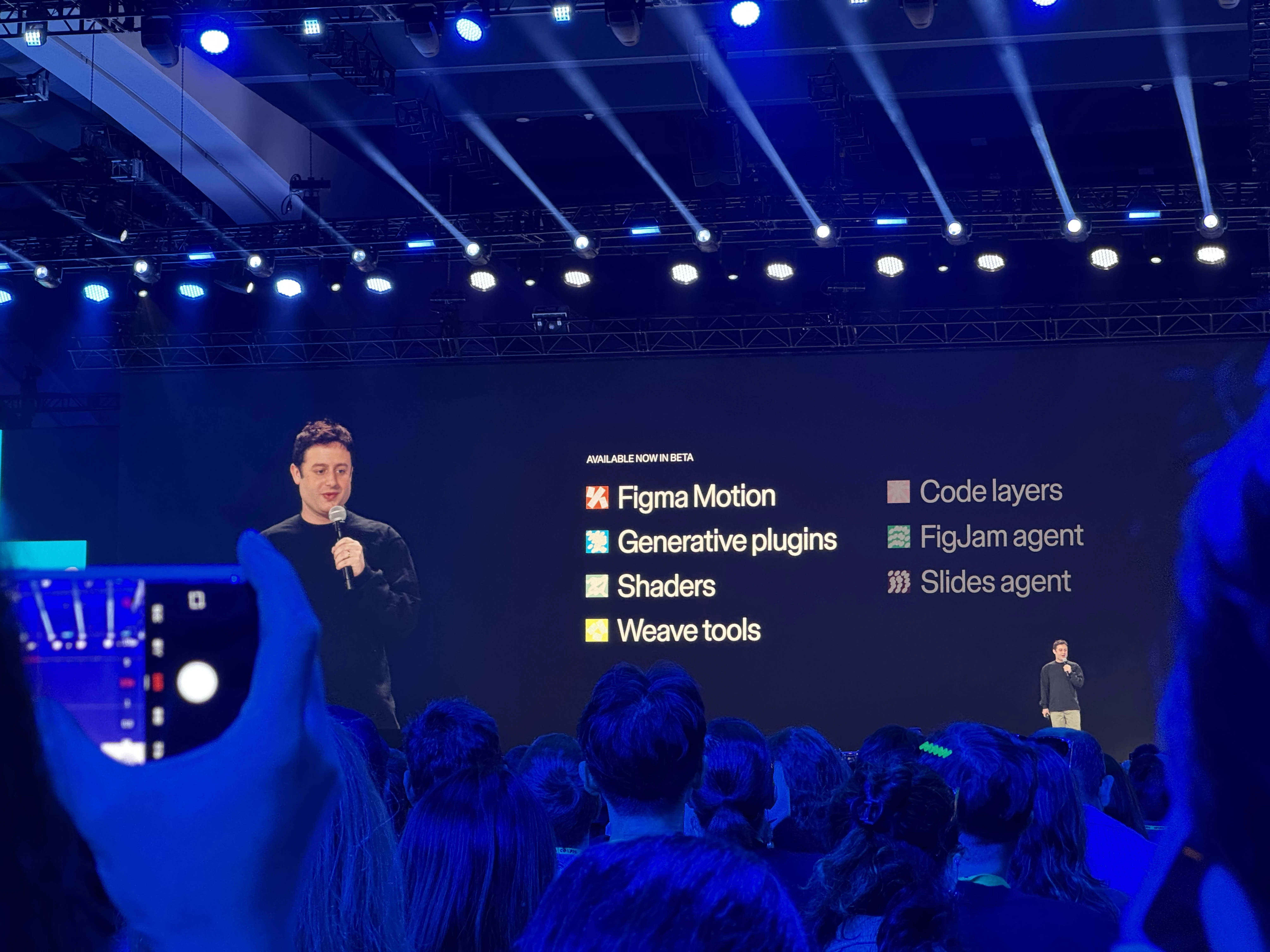 [fig 2] Dylan on stage at Config 2026.
My clue: raising the ceiling
For now, that's Figma's answer to the "What's next?" question. But what about mine?
One quote from Dylan's keynote stayed with me:
"AI lowers the floor, but what about raising the ceiling?"
With that question in mind, I watched around 20 talks on YouTube in the week after Config. Two sessions, in particular, gave me some clues and pushed me into deeper thinking:
- It used to be hard to be average by André Anjos
- The rules are the art: creating with AI by Holly Herndon
AI lowers the floor, and average becomes easy
The idea that AI lowers the floor is easy enough to understand. In the past, even being average was hard. It took years of training and experience to make something good enough.
Today's AI models can generate those "good enough" results in minutes. It has become easier for almost anyone, even people without formal training, to build something average. That's one reason everyone wants to be a builder now. We're seeing a flood of to-do apps, trackers, dashboards, and other familiar product forms.
And somehow, we can feel when something has been "vibed" into existence. It feels generic, bland, and lifeless.
Do we actually need to raise the ceiling?
Before we talk about how to raise the ceiling, maybe we first need to ask whether we actually need to.
Look around — we're surrounded by things that are simply "good enough." Think about those internal admin pages: nobody cares whether they look beautiful, as long as they do their job. Think about the meals we eat every day: we don't need them to be Michelin-level, as long as they give us the nutrients we need.
In that sense, raising the ceiling feels like a luxury for work that isn't under a deadline or constrained by resources. Most people, most of the time, aren't looking for something great. They just want to get things done.
The ceiling only matters where you care
So yes, good enough is often enough. Sometimes the tradeoff is obvious, and even desirable: ship faster, save time, move on.
But good enough stops being enough when it comes to things I truly care about. It is not enough for my design and craft.
"If I haven't tried my best on a project, I know it. And I will have to live with my average work for the rest of my life." - André Anjos
In this case, pushing myself to raise the ceiling is not optional. It's not about the glory of making something great or earning praise from others. It's about my own standards as a builder and creator.
And maybe, as human beings, we are born to build and create. We are built to improve things, to make them better than they were before, to raise the ceiling in the places that matter to us. It comes naturally, and it doesn't require anyone else to agree.
So what do I care about?
So now my answer is this: we should continue to push the ceiling in the areas we care about. But that raises another question: what do I care about?
Holly Herndon mentioned an analogy of angels and devils:
"Devils appear as things that you like, and angels appear as things that you fear." - Holly Herndon
Devils are the things we easily lean toward: building whatever is trendy, letting AI do most of the work — even the thinking — and creating more slop. Angels are the more uncomfortable questions we fear and avoid: what do I care about? What should I build? What do I really want in this ever-changing world?
Finding that answer is uncomfortable. It requires me to sit with questions that don't have immediate outputs, easy metrics, or obvious rewards. But maybe that discomfort is the point. It is where I can start to separate what I genuinely care about from what is merely trendy, convenient, or easy to generate.
So I choose to continue down this uncomfortable path, to find my own answer to the deeper question of what I really want.
And I hope you start your journey, too. If you've already found your answer, congratulations — I'd love to hear it.